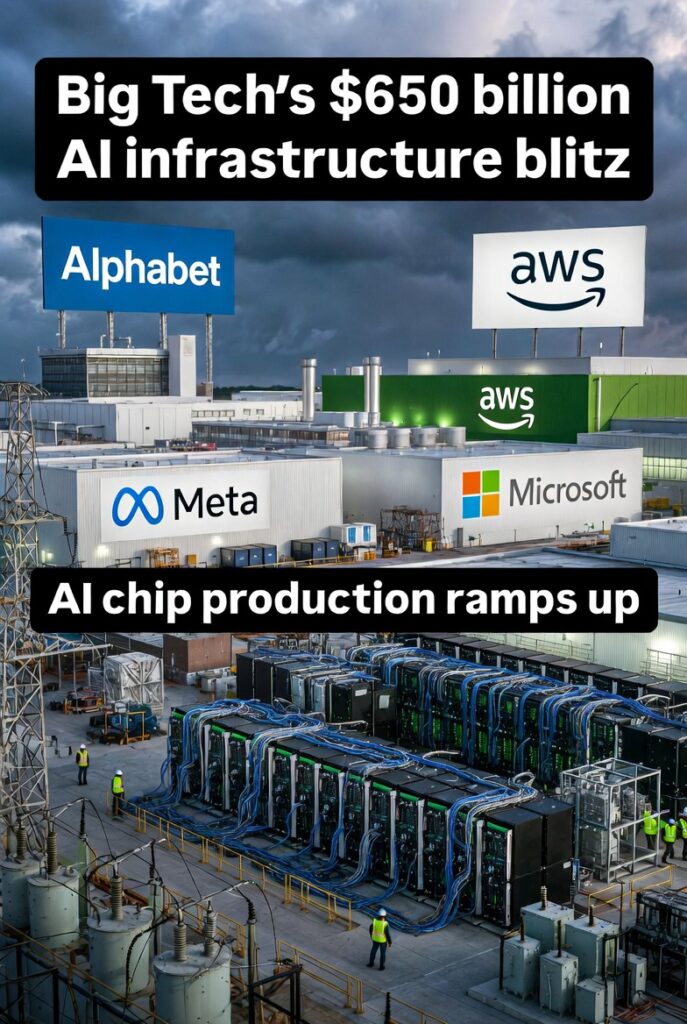
The numbers are almost incomprehensible. Alphabet (Google), Amazon, Meta, and Microsoft—the four hyperscalers at the heart of the AI revolution—are collectively forecasting capital expenditures (capex) of around $650 billion in 2026. That’s a jaw-dropping ~60-67% surge from their combined ~$381-388 billion in 2025, with some estimates pushing toward $700 billion when including optimistic ranges. This isn’t pocket change; it’s more than the GDP of entire nations like Portugal or Israel, and it’s almost entirely laser-focused on fueling the explosive growth of AI.Break it down by company (based on their latest guidance and analyst projections):
- Amazon leads the pack with a staggering $200 billion planned for 2026—mostly pouring into AWS data centers to handle surging AI workloads. That’s over 50% more than 2025 and exceeds the entire U.S. energy sector’s annual investment.
- Alphabet (Google) is targeting $175-185 billion, roughly doubling its spend for the second year running to power Gemini models (now at 750 million monthly users), Google Cloud, and enterprise AI tools.
- Meta is guiding $115-135 billion—potentially an 87% jump—to scale Llama models, AI-driven ads, and massive compute clusters.
- Microsoft hasn’t locked in an exact figure yet, but analysts project $97-145 billion (fiscal year), driven by Azure expansions and its deep OpenAI ties—up sharply from prior years.
Why this unprecedented frenzy? Jensen Huang nailed it: AI demand for training, inference, and especially agentic systems (autonomous AI that acts independently) is “sky high.” We’re building the digital backbone for the next era—multimodal models, enterprise agents, robotics integration, and beyond. Roughly 75% of this spend (~$450-500 billion) flows straight to AI-specific gear: Nvidia/AMD GPUs, custom silicon, servers, networking, and hyperscale facilities that dwarf anything before.
 But the scale brings massive ripple effects that could reshape economies, energy systems, and markets.
1. The Energy Crunch – Grids on the Brink
These data centers aren’t just buildings; they’re power-hungry beasts. A single large AI-focused facility can consume as much electricity as 100,000+ households, with the biggest new ones demanding 20x that. Projections show U.S. data center demand jumping from ~4.4% of national electricity in 2023 to 6.7-12% by 2028—potentially more than all energy-intensive industries (steel, cement, chemicals) combined.Grids are already straining: interconnection queues stretch years, transformer/cable lead times have doubled, and regional blackouts or delays are rising. In places like northern Virginia, voltage issues have already knocked dozens of centers offline temporarily. Water usage for cooling is spiking too, clashing with local resources. Globally, the IEA warns data center electricity could double to ~945 TWh by 2030—equivalent to Japan’s entire usage today. Without massive upgrades (new transmission, gas/nuclear backups, renewables at scale), 20%+ of planned projects risk delays, and residential bills could climb as costs get socialized.
2. Tax Windfalls from Trump’s “One Big Beautiful Bill” (OBBBA)
Signed last summer, this GOP legislation delivered generous depreciation breaks, R&D credits, and accelerated write-offs—perfect for capital-intensive AI builds. Big Tech is cashing in hard: Amazon’s federal tax bill plunged from ~$9 billion in 2024 to just $1.2 billion in 2025 despite soaring profits. Meta dropped from ~$9.6B to $2.8B, and Alphabet saw similar relief. Collectively, four giants (Amazon, Alphabet, Meta, Tesla) saved ~$51 billion in taxes last year alone vs. the standard 21% rate. These perks supercharge the build-out by freeing cash flow, but critics argue they’re shifting burdens elsewhere while AI giants scale unchecked.
3. Market Volatility & Investor Jitters
Wall Street’s been on a rollercoaster. Capex guidance blew past estimates by ~$150 billion in some cases, sparking sell-offs on fears the spend tsunami could outpace near-term returns—free cash flow at Meta could drop 90% temporarily. Stocks swung wildly last week, but rebounds followed as Oracle, Microsoft, and others showed resilience. Long-term bulls see this as “existential” infrastructure for dominance; skeptics worry it’s a bubble-building road to nowhere if monetization lags.
This isn’t just capex—it’s the foundation of the agentic AI era. If you’re building in tech, robotics, cloud, or even energy, this wave will touch (and potentially disrupt) everything. The winners will control compute at planetary scale; the losers risk being left in the dust.